
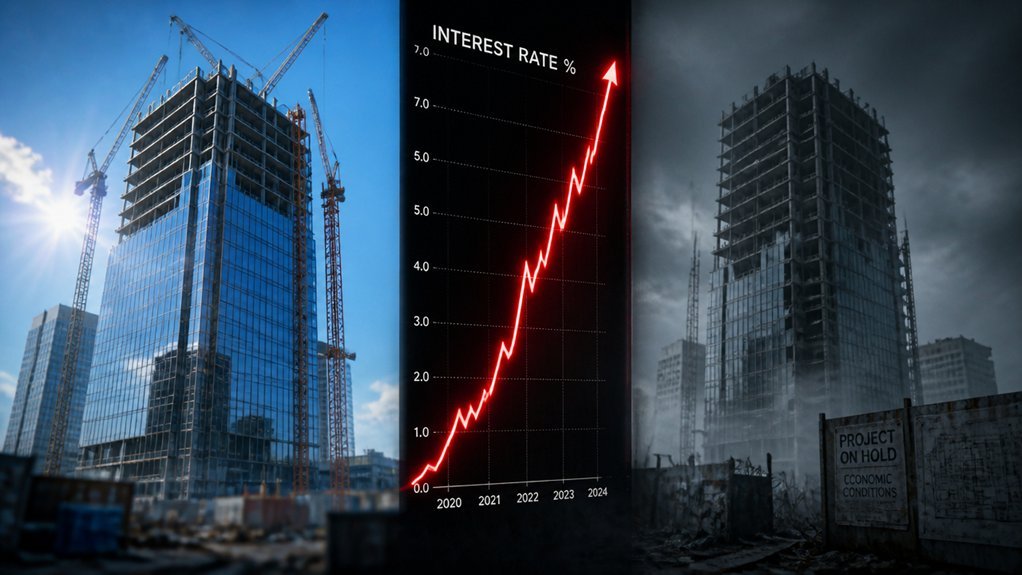
Commercial real estate development depends on a fragile financial equilibrium. When interest rates climb, borrowing becomes more expensive almost immediately. Profit margins shrink under this pressure, and project cash flows start to look uncertain. Developers suddenly find themselves navigating a much tighter landscape.
Lenders respond to rising rates by tightening their standards. Approval processes drag out longer than before, and financing options that once seemed reliable disappear. This shift leaves developers with only hard choices: push back timelines, abandon deals entirely, or pivot toward existing properties instead of groundbreaking new ones.
The ability to read these economic signals matters more than ever. Astute developers track rate movements closely and adjust their strategies before conditions worsen. Those who grasp how rates reshape project fundamentals position themselves to survive, and sometimes even capitalize on, the volatility that defines today’s market.
How Rising Debt Service Thresholds Kill Project Economics

When interest rates climb, the cost of borrowing money increases greatly, which forces commercial real estate developers to allocate more capital toward debt service payments. Higher rates compress profit margins considerably.
A project financed at 4% interest requires different cash flow structuring than one at 7% interest. Developers must increase rental income projections or reduce project scope to maintain viability.
Banks simultaneously tighten lending standards, demanding higher down payments and stricter debt-service-coverage ratios. Projects that penciled out at lower rates become unfinanceable.
This situation eliminates marginal deals from the pipeline, reducing new construction activity across markets.
When Lenders Tighten the Tap: Why Banks Reassess Risk
Risk reassessment fundamentally reshapes lending behavior during periods of rising interest rates. Banks evaluate borrower creditworthiness, property cash flow, and market conditions more rigorously. Higher rates compress profit margins, forcing lenders to demand stronger financial reserves, lower loan-to-value ratios, and documented exit strategies.
Institutional investors face stricter underwriting requirements, longer approval timelines, and reduced leverage availability.
Regional banks, particularly those exposed to commercial real estate concentrations, implement tighter lending standards faster than national institutions. This cautious approach protects lender balance sheets but simultaneously constrains capital availability, reducing viable project financing options for developers and slowing market activity across sectors.
Why Higher Rates Crush Property Valuations
The constrained lending environment created by stricter bank standards directly impacts how investors calculate property values.
Higher interest rates increase borrowing costs, reducing the income investors can expect from properties. When cap rates rise, property prices fall because buyers demand greater returns on their investments.
A commercial building generating $500,000 annually becomes worth considerably less when discount rates climb from 5% to 7%.
Investors reassess their projections, factoring in elevated mortgage payments and reduced cash flow. This mathematical reality means developers abandon projects, transactions stall, and valuations across office, retail, and industrial sectors decline sharply.
Why Developers Delay or Cancel Projects When Rates Climb
Rising interest rates force developers to recalculate project economics, often revealing unfavorable returns. When borrowing costs increase, construction financing becomes considerably more expensive, reducing profit margins on residential and commercial developments.
Developers frequently postpone projects until market conditions improve, protecting capital from negative returns. Some cancel plans entirely, shifting focus to existing portfolios instead. Higher rates affect land acquisition decisions, as developers reassess whether projected revenues justify increased debt service.
Projects with longer timelines face greater risk exposure to rate fluctuations. This delay strategy allows developers to preserve resources, wait for rate stabilization, and ultimately pursue ventures with stronger financial fundamentals and acceptable return thresholds.
Hedging Your Development Timeline: Strategic Responses to Rate Uncertainty
How can developers protect project timelines when interest rate movements remain unpredictable? Several strategies exist to manage this risk effectively.
Developers can lock in construction financing early, securing rates before potential increases occur.
Interest rate swaps allow developers to exchange variable rates for fixed ones, reducing uncertainty.
Phased development approaches spread costs across multiple periods, limiting exposure to rate spikes.
Some developers negotiate rate caps with lenders, establishing maximum borrowing costs.
Maintaining higher cash reserves provides flexibility to absorb rate increases without timeline disruption.
Diversifying funding sources, including equity partnerships and mezzanine financing, reduces reliance on traditional debt.
These methods help developers navigate uncertainty while maintaining project schedules.
Tenant Leasing Impact: Why It Matters When Rates Rise
When interest rates climb, tenant leasing strategies become increasingly critical to project viability. Higher borrowing costs reduce development returns, making pre-leasing essential before construction begins.
Developers securing long-term leases with creditworthy tenants, such as national retailers or established corporations, demonstrate reduced financial risk to lenders. This occupancy commitment typically allows access to better financing terms and lower interest rates.
Conversely, speculative projects without committed tenants face higher borrowing costs and extended holding periods.
Market conditions determine lease terms, pricing flexibility, and tenant concessions. Properties in strong markets command premium rents, offsetting rate pressures.
Weak markets require aggressive tenant recruitment strategies and incentives.
Reading the Fed: Positioning Your Project for the Next Rate Cycle
Understanding Federal Reserve policy decisions and communication patterns helps commercial real estate developers anticipate rate movements, adjust financing strategies, and time project launches accordingly.
Developers monitor Fed statements, economic data releases, and inflation trends to gauge future direction. Key indicators include employment reports, GDP growth, and consumer spending patterns. By tracking these signals, investors can lock in favorable rates before increases occur, refinance debt strategically, or delay projects during uncertain periods.
Historical rate cycles demonstrate that early positioning provides competitive advantages. Regular analysis of Fed communications enables teams to make informed decisions about acquisition timing, construction schedules, and capital allocation throughout economic cycles.
Frequently Asked Questions
How Do Interest Rate Changes Affect Existing Fixed-Rate Mortgage Obligations?
Fixed-rate mortgage obligations remain unaffected by interest rate changes. Borrowers continue paying the same principal and interest throughout the loan term, regardless of market rate fluctuations. This provides payment stability and protection against rising rates.
What Role Do Interest Rate Swaps Play in Managing Development Financing Risks?
Like a financial shield protecting against market volatility, interest rate swaps enable developers to exchange floating-rate obligations for fixed rates, stabilizing project costs. This risk management tool locks in predictable financing expenses, reducing uncertainty during construction phases and improving project feasibility assessments.
How Are Construction Loan Interest Rates Determined Differently Than Permanent Financing?
Construction loan rates are determined by shorter time horizons, higher risk profiles, and frequent rate adjustments tied to prime or LIBOR, whereas permanent financing rates reflect longer amortization periods, lower risk assessments, and fixed or stable rate structures based on market conditions.
Which Commercial Real Estate Sectors Are Most Resilient During High Rate Environments?
Essential-use properties such as grocery-anchored retail demonstrate resilience when rates spike, as their stable tenant income streams justify higher financing costs. Industrial and multifamily sectors similarly weather rate increases through consistent cash flows and tenant demand.
Can Developers Refinance Projects Mid-Construction if Rates Drop Significantly?
Developers can refinance mid-construction projects when rates drop, though it depends on the lender’s terms and the project’s progress. Most construction loans include prepayment options, allowing borrowers to refinance at lower rates if market conditions become favorable.
Conclusion
Rising interest rates function as a financial headwind, reshaping commercial real estate development through higher borrowing costs, stricter lending standards, and compressed valuations. Developers responding strategically—locking rates early, diversifying funding sources, securing tenant commitments—navigate uncertainty more effectively than those remaining passive. Success requires monitoring Federal Reserve decisions, reassessing project timelines, and maintaining financial flexibility. The development landscape demands adaptive thinking rather than traditional approaches.