
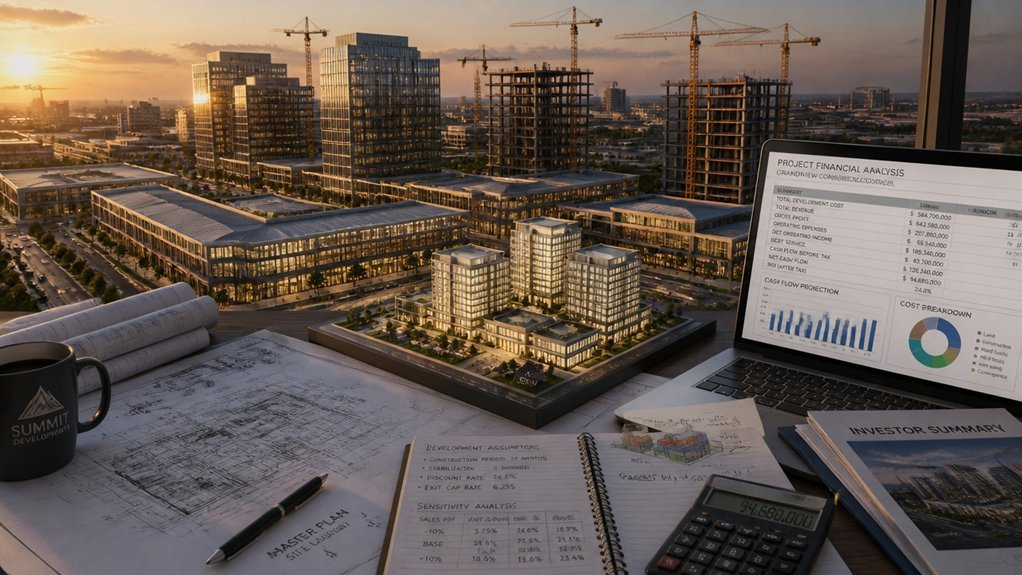
Capital costs sit at the heart of every commercial development decision. Land acquisition, construction labor, materials, and soft expenses like legal fees and permits collectively decide whether a project thrives or collapses. When these expenses outpace expected revenues, the financial foundation crumbles quickly.
Lenders scrutinize debt-to-equity ratios with little flexibility. Most draw the line at 70 to 80 percent, which means developers who let costs spiral risk immediate rejection. Staying below that threshold demands discipline from day one, not last-minute cuts.
The real battle happens before ground breaks. Early choices about site selection, design efficiency, and financing structure reshape everything that follows. Two projects with identical locations can land on opposite outcomes based on decisions made during planning.
This explains why some developments move forward with confidence while others stall indefinitely. Understanding how capital expenses reshape project economics offers a clear window into which proposals survive and which fade from the pipeline.
The Feasibility Threshold: When Do Capital Costs Kill a Project?

At what point do capital costs become so high that a commercial development project can no longer move forward?
Developers typically abandon projects when construction expenses exceed projected revenues by 20-30 percent. A retail mall requiring $50 million investment, for example, becomes unfeasible if sales projections cannot support debt service.
Financial institutions establish lending thresholds, refusing to finance ventures with debt-to-equity ratios exceeding 70-80 percent.
Market conditions, interest rates, and land acquisition costs directly impact feasibility decisions.
Projects fail when acquisition costs, construction expenses, permits, and infrastructure improvements collectively surpass available capital and investor tolerance for financial risk.
The Three Cost Buckets of Development
Development projects organize their expenses into three primary categories: land acquisition, construction, and soft costs.
Land acquisition includes purchasing property and securing necessary rights. Construction encompasses materials, labor, and equipment for building. Soft costs cover professional services such as architecture, engineering, and legal fees.
Each category notably impacts project viability. A developer might spend 20 percent on land, 60 percent on construction, and 20 percent on soft costs, though ratios vary by location and project type.
Understanding these buckets helps developers identify where expenses concentrate and where cost reduction strategies might apply effectively.
How Capital Costs Flip Project Economics
Once developers understand where project money flows, they can see how shifts in any cost bucket fundamentally reshape project returns. A ten percent increase in construction costs, for example, directly reduces profit margins unless rents rise accordingly.
Similarly, higher financing rates increase debt service obligations, requiring stronger cash flow projections.
Land acquisition costs affect overall feasibility, since expensive sites demand higher-value projects to justify expenses.
Development teams must model scenarios where costs shift upward, testing whether projects remain viable. These analyses reveal which cost variables most influence profitability, enabling smarter negotiation strategies and site selection decisions that protect investment returns.
Does Your Project Pencil Out? (ROI and Payback Models)
How will a real estate project actually perform financially over time? Developers use two primary tools: return on investment (ROI) and payback period analysis.
ROI measures total profit against initial capital, expressed as a percentage. A $10 million investment generating $2 million annually yields 20 percent ROI.
Payback period calculates how long recovery takes, typically 5-7 years in commercial real estate.
Projects pencil out when returns exceed capital costs and market risks.
Developers compare these metrics against alternative investments, debt service requirements, and opportunity costs before committing resources to development.
Capital Cost Financing Strategies to Stretch Your Budget
While ROI and payback analysis determine whether a project makes financial sense, securing the actual capital presents a separate challenge. Developers employ multiple financing strategies to extend limited budgets.
Traditional bank loans offer fixed rates, though requiring substantial down payments. Construction loans provide staged funding as work progresses, reducing upfront costs. Public-private partnerships share financial burden between government and private entities.
Mezzanine financing fills gaps between senior debt and equity. Sale-leaseback arrangements convert owned assets into immediate capital.
Phased development approaches break projects into smaller, more manageable phases requiring less initial investment. Tax increment financing captures future property tax increases for current improvements.
Cutting Costs Without Cutting Scope
After securing financing through various strategies, developers face the practical challenge of managing expenses without reducing project quality or features.
Value engineering identifies cost-saving opportunities, examining material selections, construction methods, and design specifications. Bulk purchasing of materials, competitive bidding among contractors, and phased construction timelines reduce expenses.
Strategic timing of labor, optimizing site layouts, and standardizing building components lower overhead costs. Developers negotiate with suppliers and subcontractors for better pricing.
Technology adoption, such as building information modeling, improves efficiency and prevents costly mistakes. These approaches maintain project scope while improving financial outcomes.
Location and Land Cost Decisions That Move the Needle
Location selection and land acquisition represent the foundation upon which all subsequent cost management efforts either succeed or falter.
Strategic site choices greatly influence infrastructure expenses, labor availability, and regulatory requirements.
Urban centers offer established utilities and transportation networks, reducing development costs remarkably.
Suburban locations typically provide lower land prices, offsetting longer infrastructure extensions.
Rural sites demand substantial upfront investments in roads, water systems, and electrical connections.
Developers must analyze property taxes, zoning restrictions, and environmental remediation needs before committing capital.
Market demand, demographic trends, and competitive positioning further shape location viability.
Selecting appropriate sites early prevents costly relocations and budget overruns throughout construction phases.
Frequently Asked Questions
How Do Interest Rate Changes Impact the Total Cost of Development Financing Over Time?
Rising interest rates increase borrowing costs, extending loan repayment periods and inflating total project expenses. Conversely, declining rates reduce financing burdens, improving project feasibility and developer profitability margins appreciably.
What Capital Cost Benchmarks Should Developers Expect for Their Specific Building Type and Market?
While developers often assume benchmarks remain constant, market conditions continuously shift these figures. Office buildings typically range $300-500/sq ft, while industrial averages $150-250/sq ft. Residential projects span $200-400/sq ft, depending on location and local economic factors.
How Do Contingency Reserves Affect Project Budgets and When Should They Be Adjusted?
Contingency reserves, typically 5-15% of total project costs, provide financial buffers against unforeseen expenses. Developers should increase reserves for complex projects, uncertain markets, or volatile material costs, while reducing them for straightforward developments with stable pricing conditions.
Which Cost Overruns Are Most Common in Commercial Development and How Preventable Are They?
Design changes and labor escalation represent the most frequent cost overruns in commercial development. Both are highly preventable through detailed initial planning, fixed-price contracts with contractors, and thorough scope documentation established before construction commences.
How Do Capital Costs Differ Between Build-To-Suit Versus Speculative Development Projects?
Testing the premise that tenant commitments reduce risk reveals critical distinctions: build-to-suit projects carry lower upfront capital costs since tenants finance improvements, whereas speculative developments demand substantial pre-leasing investments, making them inherently riskier financial ventures.
Conclusion
Capital costs form the foundation upon which commercial projects either flourish or crumble. Developers who navigate land acquisition, construction, and soft expenses strategically—balancing debt-to-equity ratios, market demand, and financing conditions—position themselves for sustainable returns. Those who ignore these cost structures risk financial collapse. Success requires disciplined evaluation of feasibility thresholds, honest ROI assessments, and thoughtful location decisions. Capital costs are not obstacles to overcome, but rather the blueprint determining project viability.